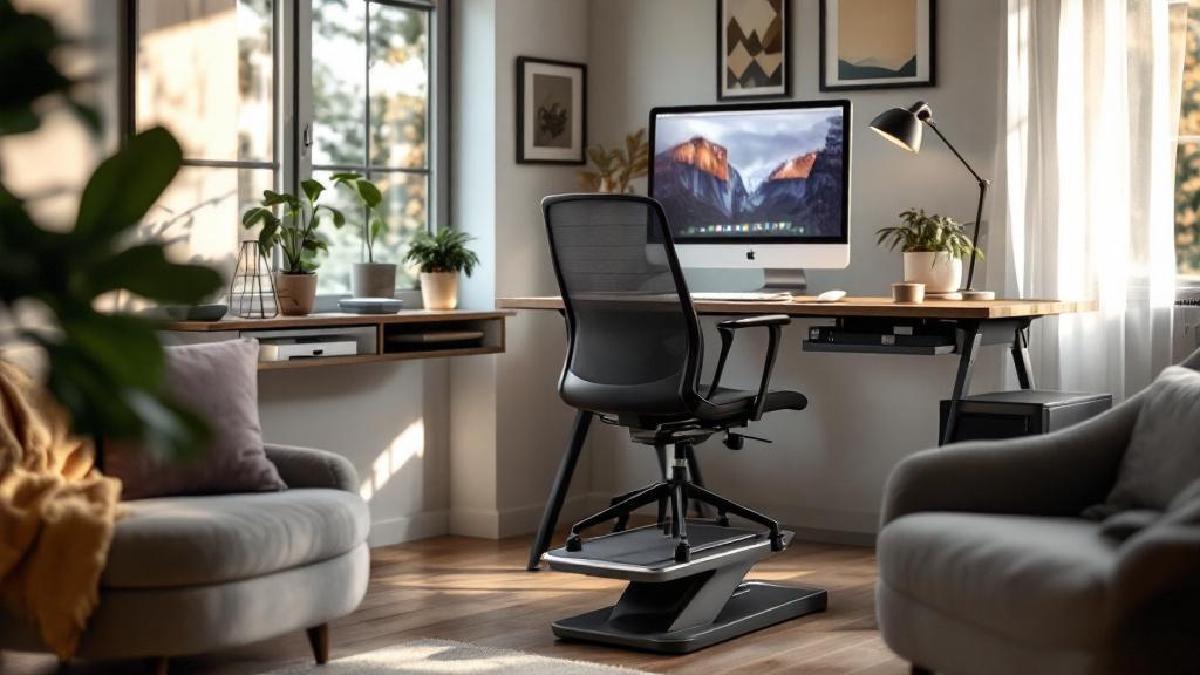
If your feet dangle when you sit at your desk — or you just can’t get comfortable no matter how many times you adjust your chair — a footrest might be the cheapest ergonomic upgrade you can make. We’re talking $25–120 for something that genuinely changes how your lower body feels after an eight-hour workday.
The logic is simple: when your feet aren’t properly supported, your thighs take the pressure. That compresses blood flow, creates tension in your lower back, and leaves you shifting around in your chair all day trying to find a position that works. A good footrest fixes that by keeping your feet at the right height and angle, so your knees sit at roughly 90 degrees and your weight distributes evenly.
We researched and compared over 15 popular footrests to find the seven best options for different budgets and needs. Whether you want a premium rocking model, a simple foam cushion, or something height-adjustable for a standing desk setup, there’s something here for you.
Quick Comparison Table #
| Footrest | Price (US/UK) | Adjustable | Key Feature | Best For |
|---|---|---|---|---|
| Humanscale FR500 | $120 / £105 | Height | Rocking motion | Premium ergonomics |
| ErgoFoam Foot Rest | $40 / £35 | No | Memory foam | All-day comfort |
| Everlasting Comfort | $35 / £30 | No | Velour cover | Budget comfort |
| HUANUO Adjustable | $50 / £43 | Height + angle | Non-slip surface | Versatility |
| ComfiLife Foot Rest | $30 / £26 | No | Massage texture | Under $40 |
| Kensington SoleMate | $45 / £39 | Height | Tilting platform | Office professionals |
| Mind Reader Foot Rest | $25 / £22 | No | Simple platform | Entry-level |
Why Use a Footrest? #
It sounds like a luxury, but ergonomists and workplace health organizations actually recommend them. OSHA guidelines state that your feet should be flat on the floor or supported by a footrest — and if your desk or chair height means your feet don’t reach the floor comfortably, a footrest isn’t optional, it’s necessary.
Here’s what a footrest actually does for you:
Reduces lower back strain. When your feet dangle or rest at an awkward angle, your pelvis tilts forward, pulling your lower spine out of alignment. A footrest corrects this by supporting your feet at the right height, which keeps your pelvis neutral and takes pressure off your lumbar region.
Improves circulation. Dangling legs compress the underside of your thighs against the chair seat, which restricts blood flow. Over time, this can cause numbness, swelling, and that “pins and needles” feeling. Elevating your feet even slightly opens up that circulation.
Encourages movement. The best footrests — especially rocking models — encourage subtle foot and leg movements throughout the day. This micro-movement keeps muscles engaged and prevents the stiffness that comes from sitting completely still.
Fits different heights to the same desk. If you share a desk with someone, or your ergonomic chair doesn’t go low enough, a footrest bridges the gap without needing to change your entire setup.
1. Humanscale FR500 — Best Premium Footrest #
Price: $120 / £105 Check Price on Amazon US → Check Price on Amazon UK →
The Humanscale FR500 is the footrest equivalent of buying a Herman Miller chair — you’re paying significantly more than the competition, but you’re getting something that’s genuinely engineered rather than just assembled.
The standout feature is the rocking motion. Rather than planting your feet on a static surface, the FR500 lets your feet naturally rock back and forth, which promotes circulation and keeps your leg muscles subtly active throughout the day. It’s the closest thing to the movement benefits of a standing desk while you’re sitting.
The build quality is immediately obvious. The base is die-cast aluminum, and the footrest platform has a textured rubber surface that grips well even in socks. Height adjusts from 4 to 7 inches with a smooth mechanism that stays where you set it.
Pros:
- Rocking motion genuinely improves circulation and reduces stiffness
- Die-cast aluminum construction — this thing will outlast your desk
- Smooth height adjustment from 4–7 inches
- Non-slip rubber surface works with shoes or socks
- Completely silent movement
Cons:
- At $120, it’s 3–4x the price of foam alternatives
- The rocking motion takes a day or two to get used to
- Heavier than foam options (not easily portable)
- Metal can feel cold in winter if you’re barefoot
Best for: Anyone who takes ergonomics seriously and wants a footrest that’ll last 10+ years. If you’re already investing in a quality chair and desk, this is the footrest that matches that level.
2. ErgoFoam Foot Rest — Best for All-Day Comfort #
Price: $40 / £35 Check Price on Amazon US → Check Price on Amazon UK →
The ErgoFoam is the footrest you see everywhere on Amazon, and there’s a good reason — it hits the sweet spot between comfort, quality, and price that most people are looking for.
It’s a dense memory foam cushion shaped into a half-cylinder with a flat top and curved bottom. The foam is firm enough that it doesn’t collapse under your feet after a few months (a common complaint with cheaper foam footrests), but soft enough that it’s genuinely comfortable for extended use.
The velvet-feel cover is removable and machine washable, which matters more than you’d think. After a few months of daily use, footrests get grimy — being able to throw the cover in the washing machine is a real advantage.
One clever touch: you can flip it over and use the curved bottom as a rocking footrest, giving you two modes from one product. The rocking isn’t as refined as the Humanscale, but it’s a nice option to have.
Pros:
- Dense memory foam holds its shape over months of daily use
- Removable, machine-washable velvet cover
- Can be flipped for a rocking mode
- Non-slip rubber base
- Good size — fits both feet comfortably side by side
Cons:
- Not height-adjustable — you get what you get
- Memory foam traps heat in summer
- Takes a day to fully expand from packaging
- The “velvet” cover attracts pet hair like a magnet
Best for: Most people. If you’re not sure what footrest to get and want something comfortable and well-made without overthinking it, this is the one.
3. Everlasting Comfort Foot Rest — Best Budget Comfort #
Price: $35 / £30 Check Price on Amazon US → Check Price on Amazon UK →
The Everlasting Comfort footrest is very similar to the ErgoFoam in concept — it’s a memory foam cushion with a velour cover — but at a slightly lower price point with a few differences worth noting.
The foam density is slightly softer than the ErgoFoam, which some users prefer for comfort but means it compresses a bit more over time. For the first six months you probably won’t notice a difference, but after a year of daily use, the Everlasting Comfort tends to flatten out more.
The cover has a plush velour texture that feels nice underfoot. Like the ErgoFoam, it’s removable and washable, though the zipper on the Everlasting Comfort feels a little cheaper.
Where this footrest wins is pure value. At $35 / £30, it’s one of the cheapest decent-quality foam footrests available, and for someone who’s never used a footrest before, it’s a low-risk way to find out if one makes a difference for you.
Pros:
- Very affordable entry point
- Soft, plush velour cover
- Removable and washable cover
- Non-slip base
- Light enough to move around easily
Cons:
- Foam is softer and compresses faster than ErgoFoam
- Zipper quality is mediocre
- No rocking mode
- May need replacing after 12–18 months of heavy use
Best for: Budget-conscious buyers who want to try a footrest without committing to a premium model. Also good as a secondary footrest for a second workstation.
4. HUANUO Adjustable Footrest — Best for Versatility #
Price: $50 / £43 Check Price on Amazon US → Check Price on Amazon UK →
If you want actual adjustability — height and angle — without paying Humanscale prices, the HUANUO is your best option. It’s a hard-surface footrest with a textured platform that tilts and locks at multiple angles, and the height adjusts via stacking sections.
This is a fundamentally different product from the foam options above. It’s a rigid platform, not a cushion, so the feel is more “office equipment” and less “pillow for your feet.” Some people strongly prefer this — it gives more precise control over your foot position and doesn’t compress or deform over time.
The non-slip surface works well with both shoes and socks, and the rubber feet on the bottom keep it planted on hard floors. On carpet, it can slide a bit — you might want to place it on a hard mat.
Pros:
- True height and angle adjustability
- Rigid platform won’t compress or deform
- Non-slip textured surface
- Durable plastic construction
- Easy to clean (just wipe down)
Cons:
- Hard surface isn’t as immediately comfortable as foam
- Can slide on thick carpet
- Adjustment mechanism requires manual setup (not on-the-fly)
- Looks more industrial than stylish
Best for: Anyone who shares a desk with others of different heights, or who wants precise control over foot position. Also great if you dislike the “sinking” feel of foam footrests.
5. ComfiLife Foot Rest — Best Under $40 #
Price: $30 / £26 Check Price on Amazon US → Check Price on Amazon UK →
The ComfiLife distinguishes itself from other foam footrests with a textured top surface that provides gentle massage-like stimulation for your feet. It’s not a true massage function — there are no moving parts — but the raised bumps on the surface create pleasant pressure points that feel good after a few hours.
The foam is a medium density that balances comfort with durability reasonably well. It’s not quite as firm as the ErgoFoam, but it holds up better than the Everlasting Comfort over time. The non-slip bottom works on hard floors, and the cover is removable for washing.
At $30, it’s priced competitively with the cheapest options while offering something a little different. If you tend to fidget with your feet while working, the textured surface gives your feet something to engage with, which can actually help with focus.
Pros:
- Textured surface provides gentle foot stimulation
- Good foam density for the price
- Non-slip base
- Removable, washable cover
- Compact size fits under most desks
Cons:
- Texture isn’t for everyone — some find it distracting
- No height adjustment
- Cover material isn’t as plush as ErgoFoam or Everlasting Comfort
- Can feel firm when new (softens over a week)
Best for: Fidgeters and anyone who likes the idea of gentle foot stimulation while working. Good value at this price point.
6. Kensington SoleMate — Best for Office Professionals #
Price: $45 / £39 Check Price on Amazon US → Check Price on Amazon UK →
Kensington has been making office accessories for decades, and the SoleMate is their take on the footrest — no-nonsense, functional, and built to sit under a corporate desk without looking out of place.
It’s a hard-surface tilting platform with two height positions and a smooth rocking motion. The angle adjusts to keep your feet comfortable whether you’re wearing dress shoes, trainers, or just socks. The SmartFit system lets you set the height based on your personal ergonomic measurements.
The build quality is solid plastic — not as premium as the Humanscale’s aluminum, but noticeably more durable than cheap foam options. This is a footrest that’ll work for years without needing replacement.
Pros:
- Clean, professional appearance
- Two height positions with tilting platform
- SmartFit ergonomic sizing system
- Durable construction from a trusted brand
- Smooth rocking motion
Cons:
- Hard plastic surface — no cushioning
- Only two height settings (not continuously adjustable)
- The rocking motion has limited range
- Slightly larger footprint than foam options
Best for: People who work in (or recreate) a traditional office environment and want something that looks professional. Also a good choice if you prefer hard-surface footrests but don’t want to pay Humanscale prices.
7. Mind Reader Foot Rest — Best Entry-Level #
Price: $25 / £22 Check Price on Amazon US → Check Price on Amazon UK →
Sometimes you just need something to put your feet on, and the Mind Reader delivers exactly that at the lowest price on this list. It’s a simple molded plastic platform with a textured surface and a slight angle. No height adjustment, no fancy features — just a flat, stable surface at a comfortable height.
Don’t expect premium materials or clever engineering here. The plastic is lightweight and can slide around on hard floors if you’re not careful. But for $25, it’s a functional footrest that elevates your feet to a reasonable height and improves your sitting posture.
If you’ve never used a footrest and want to test the concept before investing more, the Mind Reader is a zero-risk starting point.
Pros:
- Cheapest option on this list
- Simple and functional
- Lightweight and easy to move
- Textured non-slip top surface
- No assembly required
Cons:
- No height or angle adjustment
- Slides on hard floors without a mat
- Plastic feels cheap (because it is)
- No cushioning whatsoever
- May not last more than a year with heavy use
Best for: Anyone who wants to try a footrest for the first time without spending much. Also works as a temporary solution while you decide if a footrest makes a difference for you.
How to Choose the Right Footrest #
Foam vs. Hard Surface #
This is really the first decision you need to make. Foam footrests (ErgoFoam, Everlasting Comfort, ComfiLife) are immediately comfortable and feel cozy, but they compress over time and can’t be precisely adjusted. Hard-surface footrests (Humanscale, HUANUO, Kensington, Mind Reader) last longer and offer more adjustability, but some people find them less comfortable, especially barefoot.
Choose foam if: you prioritize comfort, work in socks or barefoot, and don’t mind replacing it every 1–2 years.
Choose hard surface if: you want durability, adjustability, and a more “office” feel.
Height Adjustability #
If you’re the only person using your desk and your chair height is set, a non-adjustable footrest is fine — just make sure the height works for you. But if you share a workspace, change chairs, or use a sit-stand desk where your seated height might vary, an adjustable model pays for itself quickly.
Rocking vs. Static #
Rocking footrests encourage micro-movements that improve circulation and reduce stiffness. If you tend to sit very still for long periods, a rocking model (Humanscale FR500 or even the ErgoFoam flipped upside down) can make a real difference. If you prefer a stable, planted surface, go static.
Size Matters #
Make sure the footrest fits under your desk with room to spare. Foam models are generally compact, but hard-surface platforms (especially the Kensington and HUANUO) have larger footprints. Measure your under-desk space before buying, particularly if you have a desk treadmill or other accessories down there.
Our Top Pick #
For most people, the ErgoFoam Foot Rest at $40 / £35 is the best balance of comfort, quality, and price. It’s comfortable out of the box, the cover is washable, and the dual-mode design (flat or rocking) gives you flexibility.
If budget isn’t a concern and you want the best, the Humanscale FR500 is in a different league — the rocking motion and aluminum build are worth the premium if you’re investing in long-term ergonomics.
And if you just want to try a footrest without committing, the Mind Reader at $25 / £22 is the lowest-risk option.
Pair your footrest with a good ergonomic chair and a proper desk setup, and your lower body will thank you.
Frequently Asked Questions #
Are footrests actually worth it? #
Yes — especially if your feet don’t rest flat on the floor when seated. Even if they do, a footrest encourages better posture and can reduce lower back fatigue. At $25–40 for a decent one, it’s one of the cheapest ergonomic improvements you can make.
Should I use a footrest with a standing desk? #
Not while standing — but absolutely while sitting. Most standing desk users alternate between sitting and standing throughout the day. A footrest improves your seated periods.
How high should a footrest be? #
Your knees should be at roughly 90 degrees or slightly higher when your feet rest on the footrest. For most people, that means a footrest height of 3–6 inches, depending on your chair height and leg length.
Can a footrest help with sciatica? #
It can help by reducing pressure on the backs of your thighs and encouraging better pelvic alignment. It’s not a cure, but proper foot support is part of an ergonomic setup that reduces sciatic nerve compression.
How do I stop my footrest from sliding? #
Hard-surface footrests tend to slide on smooth floors. Place a rubber mat underneath, or look for models with rubber feet (like the HUANUO). Foam footrests rarely have this problem due to their non-slip bases.