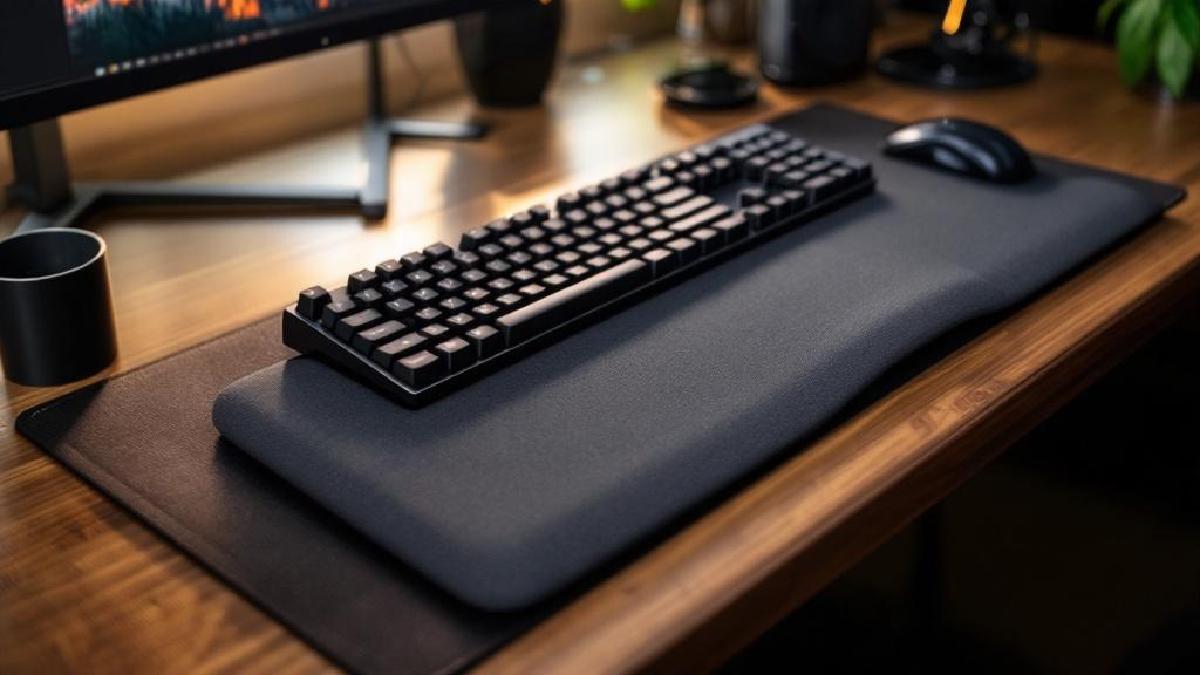
If you type for 8+ hours a day and your wrists ache by 3 PM, a wrist rest might be the cheapest ergonomic upgrade you can make. But there’s a catch — a bad wrist rest can actually make things worse by putting pressure on the carpal tunnel.
The key is resting the heel of your palm, not your wrist, and using the pad between typing bursts rather than while actively pressing keys. Get that right, and a quality wrist rest takes real strain off your forearms and shoulders.
Here are the 7 best keyboard wrist rests in 2026, covering memory foam, gel, and even wooden options.
Our Top Picks at a Glance #
| Wrist Rest | Best For | Material | Price (USD) | Size Options |
|---|---|---|---|---|
| HyperX Wrist Rest | Best overall | Memory foam | ~$20 | Full / TKL / 60% |
| Glorious Gaming Wrist Rest | Best wooden option | Stained hardwood | ~$30 | Full / TKL / Compact |
| Fellowes PlushTouch | Best gel option | Gel + antimicrobial cover | ~$15 | Full-size |
| Kensington ErgoSoft | Best for low-profile keyboards | Memory foam | ~$25 | Full / TKL |
| Deltahub Carpio 2.0 | Best ergonomic design | Memory foam | ~$40 | S / M / L |
| 3M Gel Wrist Rest | Best budget pick | Gel + leatherette | ~$12 | Full-size |
| Razer Ergonomic Wrist Rest Pro | Best premium feel | Cooling gel-infused foam | ~$35 | Full / TKL |
1. HyperX Wrist Rest — Best Overall #
The HyperX Wrist Rest hits the sweet spot between comfort, quality, and price. The cool-gel-infused memory foam stays comfortable across long sessions without getting warm and mushy like cheaper foams. The anti-slip rubber base grips your desk firmly — it won’t slide around during intense typing.
What sets it apart is the cloth cover, which is soft but durable, and the fact that HyperX makes it in three sizes: full-size, tenkeyless, and compact 60%. Whatever keyboard you’re using, there’s a matching version.
At around $20, it undercuts most premium options while matching them on comfort. This is the one we’d recommend to most people.
Pros:
- Cool-gel-infused memory foam prevents heat buildup
- Three size options (full, TKL, 60%)
- Anti-slip rubber base
- Soft cloth cover that’s easy to clean
- Great price-to-quality ratio
Cons:
- Cloth cover can stain over time
- No wrist elevation adjustment
- Memory foam firmness decreases after ~18 months
👉 Check price on Amazon US | Amazon UK
2. Glorious Gaming Wrist Rest — Best Wooden Option #
If you want something that looks as good as it feels, the Glorious wooden wrist rest is the answer. Made from stained and lacquered hardwood, it adds a premium aesthetic to any desk setup. But this isn’t just a looks play — the flat, smooth surface actually trains you to rest your palms properly rather than digging your wrists into soft foam.
Wood doesn’t compress over time like foam does, so the support is consistent for years. The rubber feet keep it planted, and the rounded edges prevent pressure points. It’s available in full-size, tenkeyless, and compact layouts.
The trade-off is that wood is obviously harder than foam. If you’re used to sinking into a plush pad, the transition takes a few days. But many ergonomic specialists actually prefer hard surfaces for wrist support because they discourage resting too much pressure on one spot.
Pros:
- Beautiful hardwood construction
- Never compresses or degrades
- Trains proper palm positioning
- Three size options
- Easy to wipe clean
Cons:
- Hard surface — not for everyone
- Heavier than foam alternatives
- No give or cushioning
👉 Check price on Amazon US | Amazon UK
3. Fellowes PlushTouch — Best Gel Option #
Fellowes has been making office ergonomics gear for decades, and the PlushTouch is their flagship wrist rest. The gel core is softer and more responsive than memory foam — it moulds around your palms instantly and springs back when you lift off. There’s no “sinking in” delay.
The Microban antimicrobial cover is a genuine differentiator, especially in shared office setups or if you eat at your desk (no judgement). It resists bacteria and odours without any special cleaning required.
At around $15, it’s a no-brainer for anyone who prefers gel over foam. The only downside is that it only comes in full-size — if you use a TKL or compact keyboard, it’ll overhang awkwardly.
Pros:
- Responsive gel core moulds instantly
- Microban antimicrobial cover
- Excellent value at ~$15
- Non-slip base
- Proven brand with decades of ergonomic experience
Cons:
- Full-size only — no TKL or compact option
- Gel can feel cold in winter
- Cover isn’t removable for washing
👉 Check price on Amazon US | Amazon UK
4. Kensington ErgoSoft — Best for Low-Profile Keyboards #
Most wrist rests are designed for standard-height keyboards, which means they’re too thick for low-profile boards like the Logitech MX Keys or Apple Magic Keyboard. The Kensington ErgoSoft solves this with a thinner profile that matches the reduced height.
The faux-leather exterior is smooth and easy to clean, and the memory foam interior is firm enough to support without bottoming out. The slight incline guides your wrists into a neutral position rather than bending them upward.
If you’re using a low-profile or laptop keyboard and other wrist rests feel too tall, this is the one.
Pros:
- Designed specifically for low-profile keyboards
- Faux-leather cover is easy to clean
- Firm memory foam that doesn’t bottom out
- Slight incline promotes neutral wrist angle
- Available in full-size and TKL
Cons:
- Faux leather can peel after 2+ years
- Too thin for standard-height keyboards
- Slightly narrow for large hands
👉 Check price on Amazon US | Amazon UK
5. Deltahub Carpio 2.0 — Best Ergonomic Design #
The Carpio 2.0 is unlike any other wrist rest on this list. Instead of a bar that sits in front of your keyboard, it’s a contoured pad that attaches to the base of your palm and slides with you across the desk. The idea is that you get continuous support while typing and mousing, not just when you’re resting.
It comes in small, medium, and large sizes based on your hand measurement, and you can buy left, right, or both. The bottom has a micro-texture that glides smoothly on any desk surface.
This is the most ergonomically sound option on the list — it keeps your wrist elevated and neutral at all times. The learning curve is about a week, but users who stick with it rarely go back to traditional bars.
Pros:
- Moves with your hand for continuous support
- Three hand sizes for a proper fit
- Works for both keyboard and mouse use
- Keeps wrist neutral at all times
- Sleek, minimal design
Cons:
- $40 per hand — need two for full coverage
- Takes a week to adjust
- Doesn’t work well on textured desk mats
👉 Check price on Amazon US | Amazon UK
6. 3M Gel Wrist Rest — Best Budget Pick #
The 3M gel wrist rest has been around for years, and for good reason — it works, it’s cheap, and it lasts. The gel core is soft without being mushy, and the leatherette cover wipes clean easily.
There’s nothing fancy here. No cooling gel, no antimicrobial coating, no size options. But at around $12, it’s the cheapest way to get genuine wrist relief. If you’re not sure whether a wrist rest is for you, start here before investing in a premium option.
The leatherette cover can get slightly sticky in hot weather, but that’s the only real complaint at this price point.
Pros:
- Around $12 — cheapest quality option
- Reliable gel cushioning
- Leatherette cover cleans easily
- Non-slip base
- Proven design that’s lasted years
Cons:
- Full-size only
- Leatherette gets sticky in heat
- No size or material options
- Plain design
👉 Check price on Amazon US | Amazon UK
7. Razer Ergonomic Wrist Rest Pro — Best Premium Feel #
Razer’s wrist rest is designed for their gaming keyboards, but it works brilliantly for office use too. The cooling gel-infused memory foam is denser than the HyperX’s, providing firmer support that doesn’t flatten out during marathon sessions. The plush leatherette cover feels genuinely premium — more like a luxury cushion than a desk accessory.
The elongated shape with tapered edges distributes pressure evenly, and the anti-slip rubber base is the stickiest we’ve tested. If you want the most comfortable typing experience money can buy and don’t mind paying $35 for it, this is the one.
Pros:
- Cooling gel + dense memory foam — best comfort in class
- Premium leatherette cover
- Very secure anti-slip base
- Available in full-size and TKL
- Excellent pressure distribution
Cons:
- $35 is steep for a wrist rest
- Leatherette isn’t as breathable as cloth
- Gaming branding may not suit a professional office
👉 Check price on Amazon US | Amazon UK
How to Use a Wrist Rest Properly #
Most people use wrist rests wrong, which can cause more harm than good. Here’s the correct approach:
- Rest between typing, not during. Your wrists should hover while actively typing. Use the rest during pauses.
- Support the heel of your palm, not your wrist. Pressing directly on the wrist compresses the carpal tunnel.
- Keep your wrists straight. The rest should keep your wrists in a neutral position — not bent upward or downward.
- Match the height to your keyboard. If the rest is taller than your keyboard’s home row, your wrists will bend upward, defeating the purpose.
What to Look For When Buying #
Material: Memory foam contours to your hand but can retain heat. Gel is cooler and more responsive. Wood is durable but hard. Pick based on your comfort preference.
Size: Match your keyboard layout. A full-size rest with a TKL keyboard looks and feels wrong. Most good options come in multiple sizes.
Height: Should match or sit slightly below your keyboard’s home row. Low-profile keyboard users need a thinner rest.
Cover: Cloth breathes but stains. Leatherette cleans easily but traps heat. Consider your climate and cleaning habits.
Frequently Asked Questions #
Are wrist rests actually good for you? #
Yes, when used correctly. They reduce contact pressure on the desk surface and help maintain a neutral wrist position. The key is using them as a resting surface between typing bursts, not as a constant support while actively typing.
Can a wrist rest help with carpal tunnel syndrome? #
A wrist rest can help prevent carpal tunnel by reducing pressure on the median nerve. However, if you already have carpal tunnel syndrome, consult a doctor — a wrist rest alone won’t fix it. It’s a preventive tool, not a treatment.
Memory foam or gel — which is better? #
Memory foam provides contouring support that adapts to your palm shape, but it can trap heat. Gel is cooler and more responsive but doesn’t contour as precisely. Neither is objectively better — it’s a preference call.
How often should I replace a wrist rest? #
Memory foam wrist rests typically last 1-2 years before the foam loses its firmness. Gel lasts 2-3 years. Wood can last indefinitely. Replace when you notice the material isn’t springing back or providing adequate support.
Do I need a separate wrist rest for my mouse? #
If you use a standard mouse for extended periods, yes. Many of the brands above also make mouse wrist rests. Alternatively, the Deltahub Carpio 2.0 works for both keyboard and mouse use.
What size wrist rest do I need? #
Match your keyboard: full-size keyboard → full-size rest, TKL → TKL rest, 60%/65% → compact rest. A mismatched size will sit awkwardly and may not support your hands in the right position.
Related Articles #
Looking to complete your ergonomic setup? Check out these guides:
- Best Ergonomic Keyboard for 2026 — pair your wrist rest with the right keyboard
- Best Keyboard for Working From Home — our full keyboard roundup
- Best Vertical Mouse for Home Office — reduce wrist strain from mousing
- How to Improve Posture Working From Home — the complete posture guide
- Best Desk Mat for 2026 — protect your desk and your wrist rest